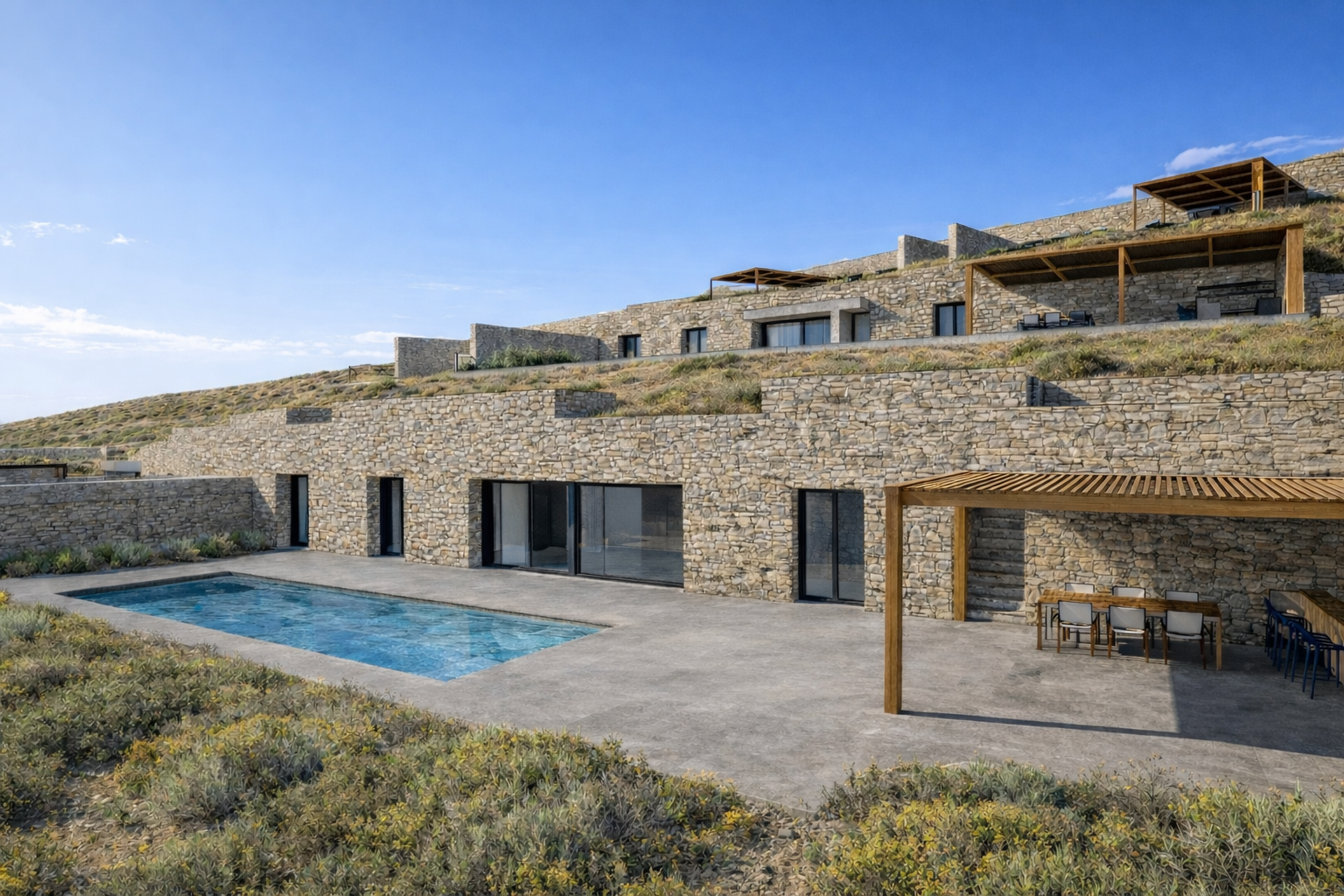
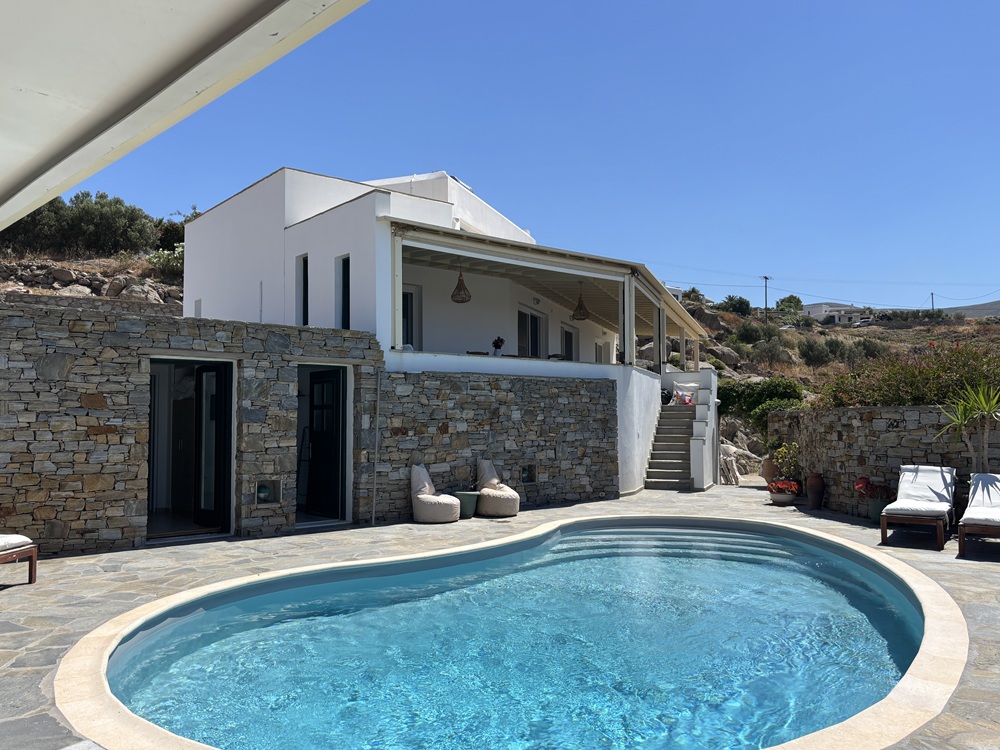
Buying a House in Greece: Costs, Process and Pitfalls
Buying a house in Greece is open to foreign buyers and follows a clear legal path: get a Greek tax number (AFM), hire your own lawyer and engineer, check the title and the legality of the building, sign a preliminary contract before a notary, then sign the final deed and register it. On top of the price, budget for purchase costs, the largest being a 3% transfer tax plus a small municipal surcharge. We use Naxos, where our office is, as the worked example throughout.

Buying a house in Greece: the process step by step
Two things surprise most first-time buyers. First, the notary certifies the deed for both parties, so the checks that protect you are done by a lawyer and an engineer you appoint yourself. Second, much of the paperwork can now be handled remotely. Our purchase procedure page has the short checklist; here is the fuller picture.
Step 1: get your AFM tax number
The AFM is a unique 9-digit tax number issued by the Greek tax authority (AADE). You need it before you can sign a preliminary contract, pay transfer tax or open a bank account. Residents abroad can get it without travelling, through the myAADElive video call service, identifying themselves with a valid passport or EU identity card; the call can be held in Greek or English. Alternatively, a representative appointed by power of attorney, often your lawyer, can apply for you.
Step 2: open a Greek bank account
Most of our buyers open an account with a Greek bank. You will use it for the deposit, the transfer tax and, later, for utility bills and the annual property tax by direct debit. Moving the money by bank transfer also leaves a clean record of where the funds came from, which makes the notary’s file simpler.
Step 3: appoint an independent lawyer and engineer
Your lawyer traces the chain of title, checks for mortgages, seizures or court claims, reviews the property’s record at the Cadastre and drafts or reviews the preliminary contract. Agree the fee in writing before work starts. Your engineer visits the house, compares it with the permits and plans, measures it and flags anything built without a permit. Never rely only on the seller’s engineer.
Step 4: the engineer’s certificate and the energy certificate
Greek law 4495/2017 (article 83) requires every transfer deed to include a declaration by the owner and an engineer’s certificate. It states that there are no illegal structures, or that any irregularities have been legalised or fall under the exceptions the law allows. The certificate is valid for two months from signature. The seller also needs an energy performance certificate (ΠΕΑ): under the EU Energy Performance of Buildings Directive, it must be shown to the buyer and handed over when a building is sold.
Step 5: the preliminary contract and deposit
Under the Greek Civil Code, a preliminary contract takes the same form as the final contract (article 166), and contracts on real rights in property must be made before a notary (article 369). In practice, that means the preliminary contract for a house is also signed at the notary’s office. The deposit is a matter for negotiation. What matters is that the contract states the deadline for the final deed, the documents the seller must deliver, and what happens to the deposit if either side walks away.
Step 6: transfer tax, final deed and registration
Before signing, buyer and seller file a joint transfer tax declaration, and the buyer pays the tax within three working days. The notary opens the digital transfer file on akinita.gov.gr, which pulls the required documents directly from the tax authority, social security, the Cadastre and the Technical Chamber, and the tax and fees can be paid online. After signing, the deed is registered with the Cadastre or the competent land registry, and the house is legally yours.
What it costs: taxes and fees on a Greek purchase
These are the purchase costs we could confirm from official sources in October 2026. Most of them fall on the buyer.
| Item | Amount | Notes |
|---|---|---|
| Transfer tax (ΦΜΑ) | 3% of the taxable value | Paid by the buyer before the deed |
| Municipal surcharge | 3% of the transfer tax | 3.09% of the value in total |
| VAT on new buildings | Suspended until 31 December 2026 where the builder has applied for the suspension | Only relevant for new builds; your notary confirms which regime applies |
| Cadastre registration | 5‰ of the value (0.5%) plus a €20 fixed fee | Fee scale set in January 2026 |
| Notary | Fee based on the value, plus VAT | Ask the notary for the exact figure |
| Lawyer, engineer, surveyor | Agreed fees | Get written quotes first |
A quick example: on a taxable value of €300,000, transfer tax plus municipal surcharge comes to €9,270 and the Cadastre fee to about €1,520, before notary, lawyer and engineer fees. The taxable value is worked out by the notary and the tax office and is not always the same as the agreed price. A first home exemption from transfer tax exists, but it is meant for buyers who live in Greece or will settle there within two years, so it does not cover a holiday home.

House prices on Naxos: what our listings show
There is no meaningful single average for Greece; Athens, Mykonos and a Peloponnese village are different markets. What we can share is asking prices in Real Naxos listings, October 2026, across 140 properties. These are asking prices, not sale prices.
- Houses: median about €570,000, from €50,000 to €2,000,000, or roughly €3,860 per m² of floor area.
- Apartments: €190,000 to €380,000, about €4,300 to €6,000 per m².
- Building plots: median about €110,000, around €215 per m² of land.
- Agricultural land: median about €205,000, around €43 per m².
Location moves the price as much as size. The west coast (Plaka, Mikri Vigla, Agios Prokopios, Agia Anna, Kastraki) and Naxos Town are the most expensive: houses in Plaka are listed at about €4,700 per m², homes in Chora at about €5,000. Inland villages such as Filoti, Sangri, Vivlos and Galini are the most affordable, with median asking prices of about €100,000 to €180,000 across all types. Browse our houses for sale or all properties on Naxos.
Common pitfalls when buying a house in Greece
Most purchases go smoothly. When they do not, it is usually for one of these reasons.
- Unpermitted extensions. An enclosed veranda, an extra room or a pool without a permit can block the engineer’s certificate, and with it the deed. Have the engineer inspect before you sign anything.
- Incomplete titles. Island houses are often inherited by several relatives, some living abroad. Every co-owner must sign, and every inheritance must be properly accepted and registered.
- Cadastre records. For areas of Naxos, the Hellenic Cadastre began posting its cadastral data for owners to check in January 2026. Make sure the record matches the title deed and the real boundaries.
- Land outside the town plan. Not every plot can be built on, and the rules differ inside and outside the plan. We cover this in our guide to buying land.
- Access and utilities. Confirm legal road access and connections to water and electricity.
- Paying too early. Do not hand over money before your lawyer has checked the title and the preliminary contract is signed before a notary.
- Running costs. Property tax, maintenance and insurance add up; see our holiday home budget guide.
Annual property tax and taxes back home
Greece’s annual property tax is ENFIA. It is charged on the property rights you hold on 1 January of each year, whatever changes later in that year. AADE posts the assessment online; for 2026 it could be paid in one go or in 12 monthly instalments, the first due on 31 March 2026. Your home country may also tax income from a Greek property, or require you to declare it, depending on its own rules and any tax treaty with Greece. Check this with a tax adviser at home before you buy, especially if you plan to rent the house out.
FAQ
Can a foreigner buy a house in Greece?
Yes. Buyers from the EU and from outside it go through the same notarial procedure. If you are not an EU citizen, ask your lawyer early whether any extra requirement applies to you or to the property’s location.
How much does it cost to buy a house in Greece?
Beyond the price, expect transfer tax of 3% plus the municipal surcharge, a Cadastre fee of 0.5% plus €20, and fees for the notary, lawyer and engineer. On Naxos, the median asking price for a house in our October 2026 listings is about €570,000.
How long does buying a house in Greece take?
It depends mostly on the paperwork. When the title and the building are in order, the steps move quickly. In the pilot phase of the notaries’ digital transfer file, sales were completed in about one working day on average when there were no earlier issues to clear.
Do I pay property tax every year in Greece?
Yes, ENFIA is due every year on property held on 1 January, payable in one go or in monthly instalments through the AADE portal.
More answers are in our FAQ. If you are thinking about a house on Naxos, we are happy to talk it through and put you in touch with the right professionals: contact us.